

















A selection of research projects undertaken over the last ten years Mental 2001-04 Exploring the creative processes of the mind with Professor John McLachlan (biologist) – University of Durham. Science papers:
|
|||||||||||||||||||||
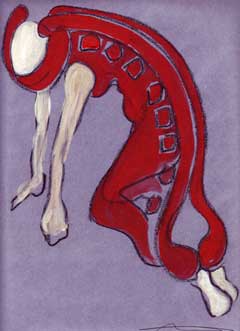
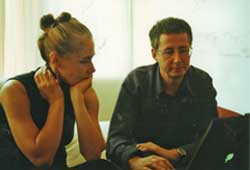
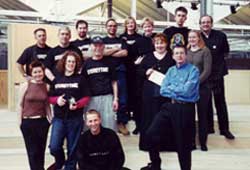
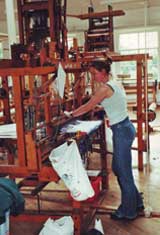
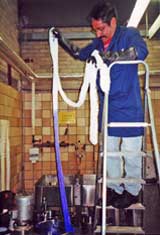
<td >Dyeing at Herriot Watt University for the Death Coat
|
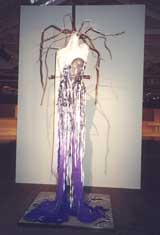
Death Coat | ||||||||||||||||||||

 |
 |
|||
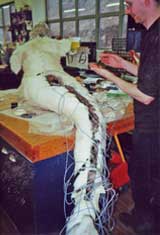
| Installation of fibreoptics and touch sensors at the University of York |
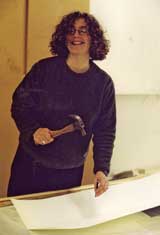
Rachel Hazel working on Amygdala, the giant book of human emotion |
 |
||
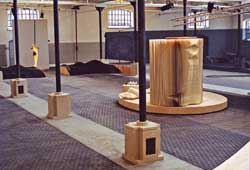
| Oksnehallen Gallery, Copenhagen. Mental landscape designed by Cliff Nichols, Dean of Chelsea School of Art, 2001 | ||
Make Me Wash Up 2003
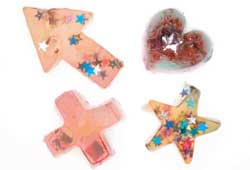
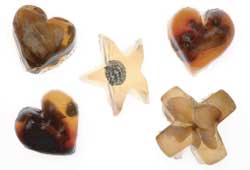
A second Unilever commission to provide stimulus to the Persil washing up team. These jellies were made in themes; disco jellies to encourage children to wash up and ‘the naturals’ which had floating within them flowers, shells and blossom. Created to make the product distinct from the competition.
 |
 |
|
| Washing up jellies – ‘disco’ | Washing up jellies – ‘the naturals’ | |
Forensic Dress 2003
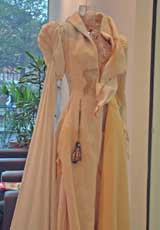
Unilever commission for Persil – A dress collaboration with Gary Page.
The dress/coat is printed with everything that stains – blood, Ribena, rust and red wine. It is made with domestic textiles, Victorian tea towels, net curtains, mattress ticking, dishcloths and blankets.The coat has hidden within it’s detail and petticoats the tale of two lovers told through the need to explore the piece forensically in order to find out which one killed the other and why. Displayed at Unilever headquarters for a year.
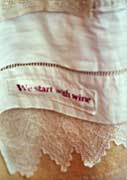 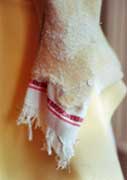 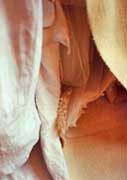 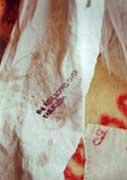 |
| Forensic Dress – details of petticoat and domestic textiles with forensic clues hidden among them |
 |
 |
|||
| Forensic Dress | Energy Project | |||
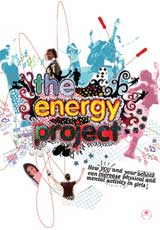
The Energy Project 2003-07
A physical exploration of female energy in 3 London schools, results of which determined a new trial timetable for each school, for the best use of energy on any given day and its impact on enjoyment and learning in 2006/7 with the Women’s Sports Foundation, Creative Partnerships and the University of Sheffield Hallam (Dept of Health and Wellbeing). This collaboration was funded by WSF and DFES.
Four Women 2004
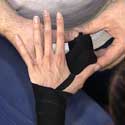
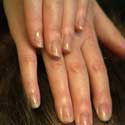
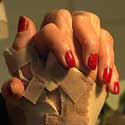
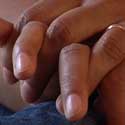
Commissioned by the Dove brand (Unilever), this was an open brief to provide creative stimulus to the team. I chose to make a film about women who lived through their hands, and to try and portray the beauty in their lives through the way in which they had created and mastered them. The four very different women were Shanee, the women's featherweight world boxing champion; Anna, a healer; Sharlot, a couturier from Iraq; and Tracy, a mother and writer.
 |
 |
 |
 |
|||
| The boxer | The healer | The couturier | Mother and writer | |||
Thought Island 2004
A collaborative project with Francesco Draisci (architect).
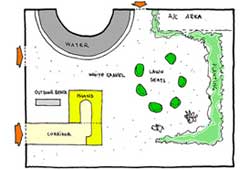
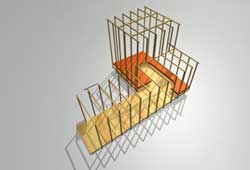
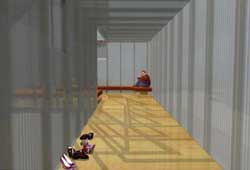
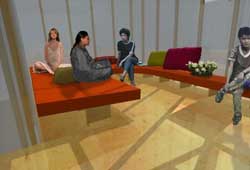
Commissioned by Unilever for its Crawley Foods Division site. The space was designed as a place for contemplation, peace and day dreaming, away from the office atmosphere but built to float as a translucent structure in the light well of the complex. All the materials were choosen for their tactile and sensory qualities.
 |
 |
|
| Positioning plan for Thought Island within light well |
Skeleton structure for Thought Island | |
 |
 |
|
| Gentle procession corridor | Arrival space | |
Me Kits 2004-05
An experimental transference tool between Primary and Secondary education.
Thirty Year 6 children, in their last term at Moorland’s Primary School, in Sale (Manchester), worked on creating handmade personal autobiographical books. Written contributions were made by syblings, parents, grandparents, friends and mentors, giving a holistic view of a young person’s gifts, life challenges and experience, and crucially, their natures. Taking these with them on their first induction day at Secondary school, these books provided unique and vital information, unobtainable through SATS results or school reporting, allowing their new tutors to identify, early, learning styles, social behaviors, and a precious opportunity to find a bond of trust with that child at this crucial stage of transference. (This project was trialed again with St Andrews School in South London in 2005).
“We have uncovered ‘treasure’ in the form of a flood of information from parents. We had no idea how much more there was to know about our kids, and how much parents welcomed an invitation to tell us. I had no idea one kid in my class had a kidney out at age 18 months, it makes so much sense now. We TELL parents about their children endlessly, why did we never offer them the opportunity for them to tell us what they know about them? It seems nuts now. We are now looking for several ways to let the parents voice and knowledge of their children be heard right the way through their school life – we shall be doing this for years to come” – Daniel Gauld, Deputy Head, Moorlands Primary School.
<span >Creative Labs London Sept 2004 – April 2005 and Derby Sept 2005 – June 2006
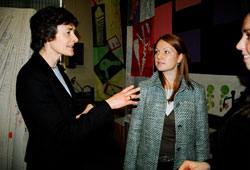
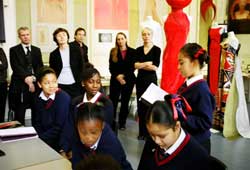
Working in collaboration with Creative Partnerships, two labs were set up for schools across South London in 2004 and across the East Midlands (Derby, Nottingham, Leicester, Bradford) in 2005/2006. Using the Primitive Streak collection and the Amygdala installation (London only) schools, teachers and other creative practitioners ran over 30 other projects using these works as the inspiration for exploring cross curricular teaching and learning projects for themselves. A film of the outputs which emanated from the lab in Derby is available on request.
“Pushing the boundaries and inventing the future needs the skills of all disciplines. Thank goodness its beginning to happen” – Estelle Morris, Minister for Education on visiting the lab in London.
 |
 |
|
| Estelle Morris MP talking to teachers from Thomas Tallis School about the lab’s work |
Estelle Morris MP with young people and Helen & Kate (Storey) working in the lab |
|
Teacher Exchange 2004-06
As a direct response to three teachers visiting the London CPLAB, an experiment in new teaching took place at Thomas Tallis School, South London. Science teachers, Alex Gibbons and Laura Harris, and art teacher, Kate Callighan, worked over several months to swap roles and deliver three new lessons, away from their own core subject, by combining the teaching of science through art, and vice versa. Kate delivered a lesson on the nature of light and the Alex and Laura had students making 3D pollens for flight. The results were remarkable, positively effecting, attention, learning ability and enjoyment and retention of new knowledge. The project has led to “whole school change”, with other exchange teaching programs taking place across core curriculum subjects. The teachers have since become national ambassadors for this way of teaching, and have traveled the country lecturing on the impact of working in this way.
<span >Eye & I 2004-06
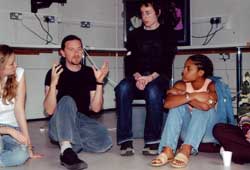
The Science of feeling, with Professor Jim Coan (neuroscientist) of University of Virginia.
 |
 |
|
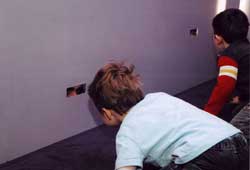
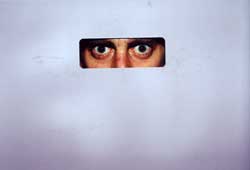
| Young child from Triangle Nursery School (south London) does ‘anger’ | Professor Jim Coan training the actors in Eye & I to trigger emotion through facial musculature, not memory | |
 |
 |
|
| Pupils from Triangle Nursery School perceive and mimic the emotions the actors eyes are emoting |
Sebastian emotes ‘fear’ with eyes only for five minutes |
|
Wonderland 2006-08
Where art meets science, with Professor Tony Ryan OBE (chemist) of University of Sheffield.
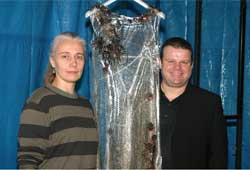
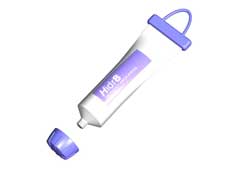
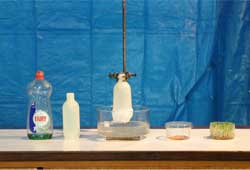
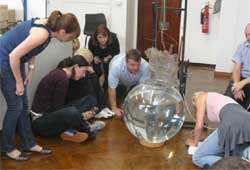
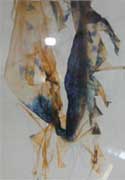
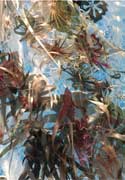
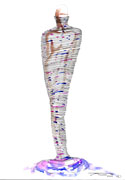
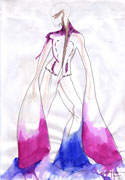
A two part installation including the Disappearing Dresses which will be created ‘live’ at The London College of Fashion Gallery space and dissolve in an Oxford Street shop window between January and February 2008, and new inventions created out of dialogue between a designer and chemist – human powered water purification and the disappearing bottle. The water purification product has a patent pending and the Pentagon and a leading third world charity have expressed interest in the delivery of this invention. The disappearing bottle is in early negotiations with a leading supermarket. The research for this project has been funded by the EPSRC, and a grant from the Arts Council Northern Ireland is funding the tour to Belfast in 2008.
 |
 |
|
| Professor Tony Ryan and Helen with the first Disappearing Dress |
New water purification device | |
 |
 |
|
| From washing up liquid bottle to flowers demonstration |
The Wonderland team testing out dissolve rates and water effects | |
 |
 |
 |
 |
|||
| Polymer becomes chiffon-like in water |
Dissolving Dress (detail) |
Coloured Bleed Column Dress |
The Bleeding Suit | |||
Ideas Can That Change The World 2005-08
A collaboration between Creative Partnerships, The Dialogue Project and Deepa Patel.
This project uniquely brings together experts and young people in true and equal dialogue, to co-create and eventually deliver ‘Ideas that can change the world’. Through a network of schools nationwide and via Facebook. The research challenge is constant, working our way through issues such as, how to make intimate and powerful conversations global; how to handle IP issues and open source opportunities between experts and young people’s co-created ideas; how to broker the best ideas into the wider world and with which partnerships? And finally, how to plan ahead for some ideas that aren’t product based, but philosophical in nature, and that may take years to detect an impact from, in a culture that wants the evidence NOW.
To date we have six global ideas we are pursuing to full delivery – the first, a system that takes advantage of all the wasted standby energy in all electrical appliances – co-created by Kunle Afolabi, aged 16 and Joel. M. Sciamma (inventor) this product has just gone forward for patent – and a second idea “A GVNQ in compassion” has identified its development partners.
 |
 |
|
|
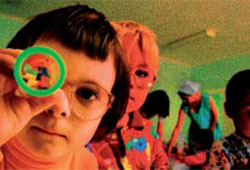
Young people fathoming
(image courtesy of Creative Partnerships) |
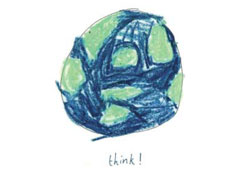
Planet earth drawing by Makaela and Stephanie, Room 13 | |
Links to other sites
London College of Fashion:
Research at LCF
Fashion at LCF
Lucy Orta
Sandy Black
Profiles of researchers at LCF
Creative Partnerships
University of Ulster
University of Virginia
Polymer Centre Sheffield
Women’s Sports Foundation
Rachel Hazell
Inflate
Terra Plana
Francesco Draisci
AIG (Malcolm Garrett)
Future of Sound (Martyn Ware)
SHOWstudio (Ross Phillips)

